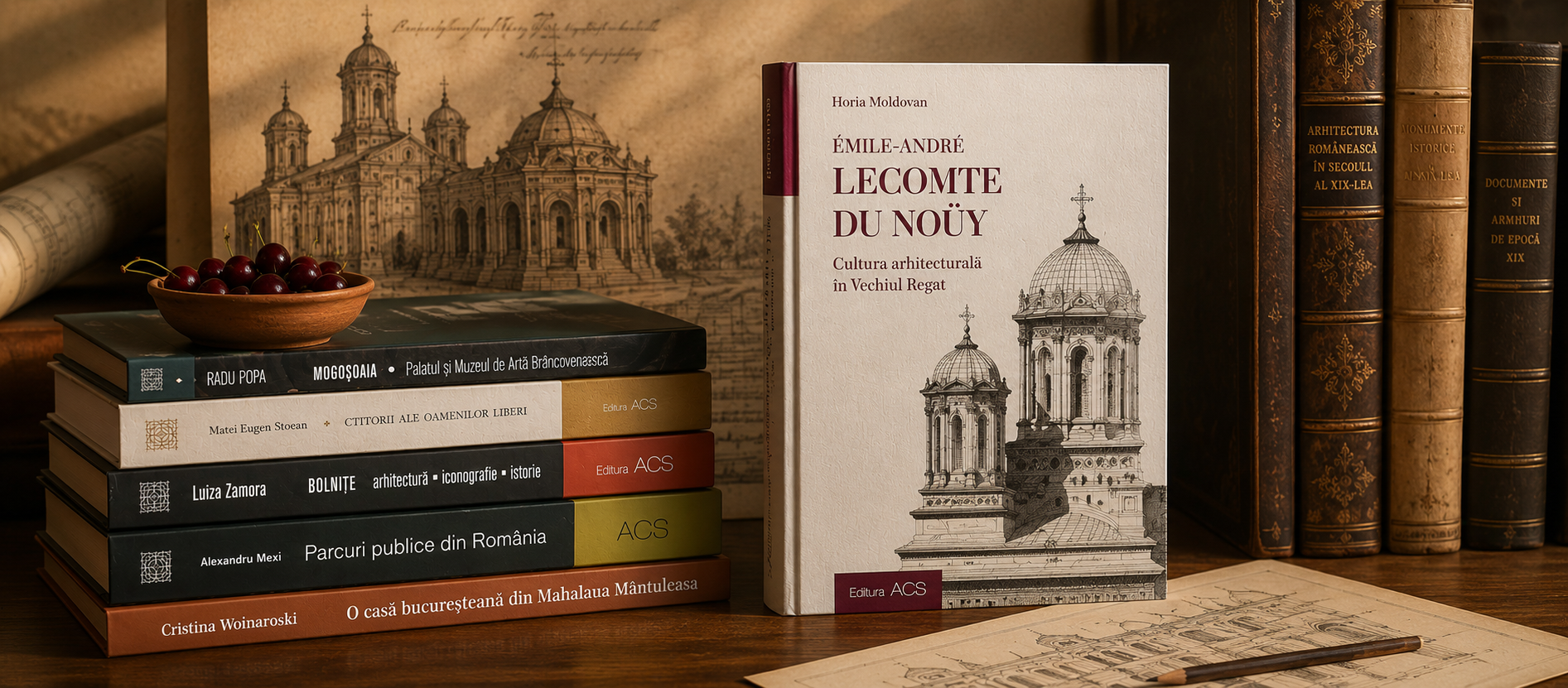
Book Launch Event
# Émile-André Lecomte du Noüy – Architectural Culture in the Old Kingdom
The monograph Émile-André Lecomte du Noüy – Architectural Culture in the Old Kingdom aims to recover, document, and critically interpret the work of one of the central figures in the history of architecture and monument restoration in Romania during the formative period of architectural modernity.
The author examines the contribution of the French architect Émile-André Lecomte du Noüy, both in the restoration of medieval monuments and in the field of new architecture, within the broader context of Western influences and the emergence of a national architectural identity. The volume addresses a significant gap in architectural historiography by offering a comprehensive, nuanced, and well-documented perspective on a complex body of work that has often been controversial and insufficiently studied.
Through its scholarly and interdisciplinary approach, the publication combines archival research, historical analysis, and critical interpretation. It draws upon an extensive corpus of documents from diverse archival collections—many previously unpublished or difficult to access—including drawings, surveys, photographs, and correspondence. These sources make it possible to reconstruct interventions on representative monuments such as the Monastery of Curtea de Argeș, the Church of the Three Hierarchs in Iași, and the Old Metropolitan Church in Târgoviște.
The project’s main activities included identifying and researching documentary sources, critically reviewing the existing literature, organizing information into thematic chapters and case studies, and writing and editing the volume in a coherent and accessible form.
The book is organized into seven chapters (in addition to the introduction and epilogue), covering the architect’s biography, the institutional and theoretical context of the period, and detailed analyses of the principal restoration and reconstruction projects under his direction.
Émile-André Lecomte du Noüy – Architectural Culture in the Old Kingdom, by Horia Moldovan, contributes to a deeper understanding of the origins of modern heritage protection practices in Romania and the ways in which they were influenced by Western models while being adapted to local realities. At the same time, the volume explores the relationship between restoration and architectural creation, highlighting the role of imagination and interpretation in interventions on historic monuments.
The book offers both specialists and interested readers a rigorous tool for information and analysis. By documenting and systematizing dispersed sources, it contributes to the recovery of a significant part of the memory of Romania’s built heritage and encourages future research in the field.
“Émile-André Lecomte du Noüy (1844–1914) has long been—and continues to be—frequently mentioned in studies of Romanian architectural history, both for his involvement in the restoration and rebuilding of some of the most representative medieval monuments and for his new architectural projects, which brought him considerable renown. The legacy he left behind is a substantial one. Although limited in scope, his work—admired by some and contested by others—played an important role in shaping attitudes and practices regarding heritage protection and restoration, as well as in the early search for a national architectural style.
Employed by the state while enjoying considerable freedom of action, Lecomte du Noüy responded to commissions from King Carol I, whom he advised on artistic matters and who frequently supported his undertakings financially, appreciating his achievements and welcoming him into the close circle of the Royal House.
Lecomte du Noüy remains one of those personalities of the Old Kingdom period whose architectural achievements, social connections, and the extensive documentation preserved from his office allow us to reconstruct a comprehensive image of what architectural culture meant during the formative stages of Romanian modernity.”
Horia Moldovan
“The remarkably meticulous study proposed by Horia Moldovan is not merely a repositioning of Lecomte du Noüy within the panorama of Romanian architecture; it is a complex reconstruction of the world of Romania’s historic monuments, articulated around his figure. The competent and richly documented interpretation offered here is indispensable for understanding how history and architecture nourished one another at the end of the nineteenth century and during the first decades of the twentieth. In this way, an essential fragment in the formation of modern Romanian culture is restored.”
Carmen Popescu
HDR Professor, École nationale supérieure d’architecture Paris-Val de Seine
Contents
Foreword
Introduction
I. Émile-André Lecomte du Noüy (1844–1914): Biographical Notes
II. Historic Monuments: Legal Codification and the Beginnings of Modern Theory and Practice (1875–1914)
III. Documenting Romanian Architecture
IV. The Restoration of Curtea de Argeș
V. The Reconstruction of the Three Hierarchs Church in Iași
VI. Reconstruction Projects
VII. The Modernity of Lecomte du Noüy’s Work
Epilogue: The Legacy of Lecomte du Noüy’s Work
Bibliography | Index
Horia Moldovan (b. 1978) is an architect and graduate of the Faculty of Architecture at the “Ion Mincu” University of Architecture and Urban Planning in Bucharest (2003), where he also completed a Master’s degree in Historic Monument Conservation (2005). He earned his PhD in Architecture in 2008 and his habilitation in 2023.
He is Professor in the Department of History and Theory of Architecture and Heritage Conservation at UAUIM, while also maintaining an independent architectural practice. A member of the Romanian Order of Architects (OAR), the Romanian Registry of Urban Planners (RUR), and a certified heritage conservation expert accredited by the Ministry of Culture, he has participated in numerous national and international conferences and symposia. He is the author and co-author of books, scholarly articles, research projects, and exhibitions in the fields of architectural history and cultural heritage conservation.
Since 2012, he has served as Vice-Dean of the Faculty of Architecture at UAUIM; since 2016, as Vice-Rector for Research, Development, Innovation, and Professional Practice; since 2020, as Dean of the Faculty of Architecture; and since 2024, as President of the UAUIM Senate and President of the National Commission for Historic Monuments.
Publisher: ACS Publishing House, 2025
Author: Horia Moldovan
Foreword by: Carmen Popescu
ISBN: 9786068922324
Number of Pages: 584
Cover Type: Hardcover
Dimensions: 23 × 16.5 cm (9.06 × 6.50 in)
Media Format: Printed book, thread-sewn binding
Art Conservation Support
This publication was supported by the Romanian Order of Architects through the Architecture Stamp Fund.
The project was co-financed by the National Cultural Fund Administration (AFCN).
The project does not necessarily represent the position of the National Cultural Fund Administration. AFCN is not responsible for the content of the project or for the manner in which its results may be used. These remain entirely the responsibility of the funding beneficiary.
Partners: “Ion Mincu” University of Architecture and Urban Planning, Patrimonescu.ro